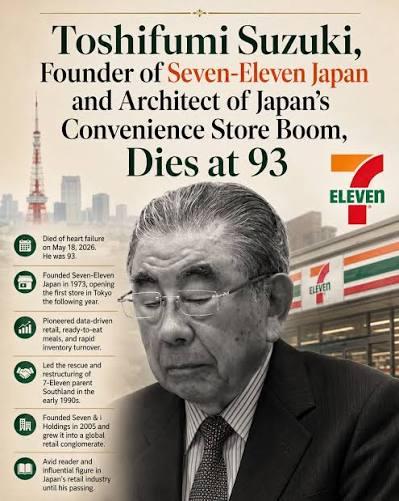
Toshifumi Suzuki, the businessman credited with transforming Japan’s convenience store culture through Seven-Eleven Japan, has died at the age of 93. Seven & i Holdings said he died of heart failure on May 18 at his home in Tokyo.
Suzuki is widely regarded as the architect of Japan’s modern “conbini” industry after introducing the 7-Eleven franchise to Japan in 1973 and opening the country’s first store in Tokyo in 1974. Under his leadership, the chain expanded into a global retail empire with more than 80,000 stores worldwide.
He revolutionized convenience retail by introducing data-driven inventory systems, rapid restocking, ready-to-eat meals, ATM banking services and utility bill payments — innovations that became standard across Japan and later influenced retailers globally.
Suzuki also played a key role in rescuing the original U.S.-based 7-Eleven parent company, Southland Corp., after its financial collapse in the 1990s, eventually bringing it under Japanese ownership. In 2005, he established Seven & i Holdings, expanding the business into a major retail conglomerate.
Known in business circles as “Hurricane Suzuki” for his demanding management style, he stepped down as chairman in 2016 following a boardroom dispute but remained an influential figure in Japan’s retail industry as an honorary adviser.